TARAS SHEVCHENKO AND THE PEREIASLAV REGION
https://kyivregiontours.gov.ua/blog/taras-sevcenko-ta-pereaslavsina
On 9 March 1814, the outstanding Ukrainian poet, artist and public figure Taras Hryhorovych Shevchenko was born. This year marks the 209th anniversary of his birth. For the Ukrainian people, he is a symbol of freedom and resilience. The Pereiaslav region holds a special place in the life and work of the Kobzar. It was here that he wrote his key works, which contain important worldview ideas that are more relevant today than ever.
From the research of his biographers, we know that in June 1843, during his journey across Ukraine, on his way to Kyiv from the estate of Hryhorii Tarnovskyi in Kachanivka, Taras Shevchenko travelled through the towns of Pryluky, Pyriatyn, Pereiaslav and Brovary; at the end of June, travelling from Kyiv to Yevhen Hrebinka in the village of Ubizhyshche in the Pyriatyn district, the poet passed through Pereiaslav for a second time. Unfortunately, no evidence has survived of this moment of Shevchenko’s acquaintance with the town, nor of the exact dates. It is known for certain that in August and October of the same year he stayed with the landowner Platon Lukashevych in Berezan and at the estate of the Repnin princes in Yahotyn (then in the Pereiaslav district).
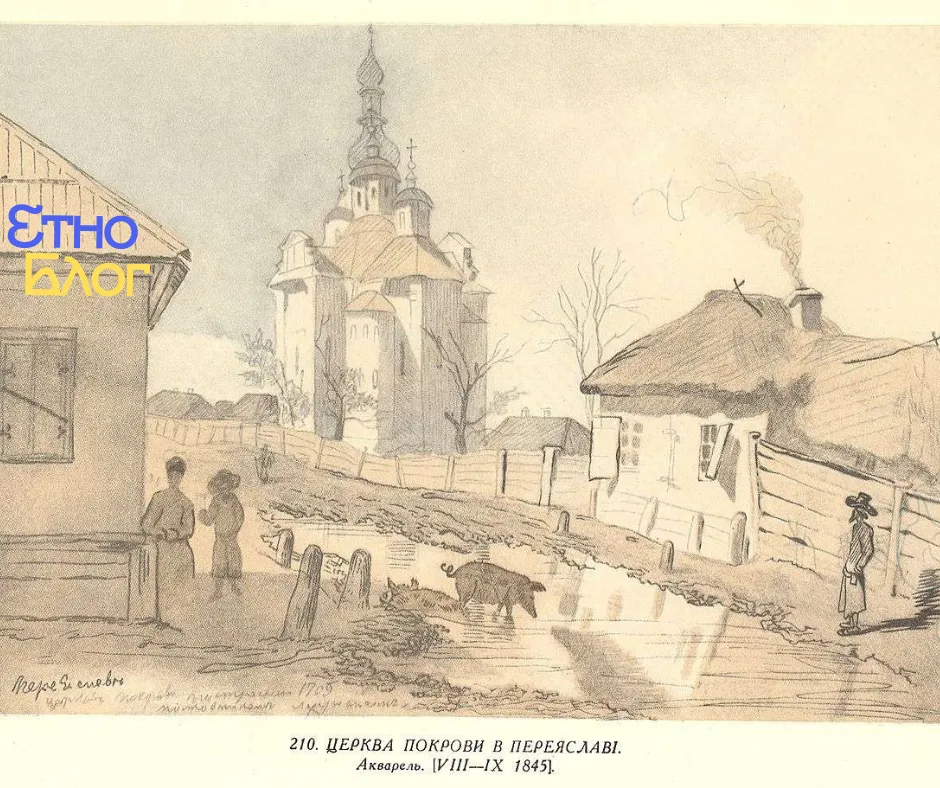
Taras Shevchenko first came to Pereiaslav in 1845, on an unofficial assignment from the Kyiv Archaeographic Commission. From 10 to 20 August he lived in the house of Andrii Kozachkovskyi, the town doctor and a teacher of medicine at the Pereiaslav Theological Seminary, whom he had met in 1841 in St Petersburg. During this period, as an artist, he made drawings and sketches of local landscapes. In Pereiaslav in particular, he depicted St Michael’s Church, the complex of buildings of the Ascension Monastery and the Church of the Protection of the Mother of God. Near Pereiaslav, in what is now the Borysivka neighbourhood, he drew the stone cross in memory of St Boris; in the village of Andrushi, landscapes with the Church of St George and the house where Taras Shevchenko stayed; in the village of Viunyshche, he depicted a landscape with a manor. All these drawings are preserved in a separate album, which also contains several works made in the Pereiaslav region without a clear location. He reflected his stay in this land in his “Archaeological Notes”, where he described some local antiquities in detail.
The poet’s stay in Pereiaslav is mentioned in the memoirs of Andrii Kozachkovskyi. In particular, he describes the evening of 19 August 1845, organised on the occasion of the poet’s visit to the town. Unfortunately, he does not mention who was present. As for the guests, it is noted that this was “a company, mostly young people”. Among them was “a gentleman of respectable age, German by origin, Protestant by faith”, who during this meeting said of Taras Shevchenko: “Here is a father! By God, lads, a father! Good health to you, father!” It is assumed that he may have been the Pereiaslav doctor Martyn Hryhorovych Shtern.
Researchers note that while staying with the doctor, Shevchenko sketched the house and made a portrait of his wife Maria Stepanivna, and also wrote the poem “To Marusia”. However, after the poet’s arrest in 1847, these works disappeared.
The poet visited Pereiaslav next in November 1845. He arrived in the town ill, having caught a cold on the way from Khorol to Myrhorod, where, as is known from Taras Shevchenko’s letter to the Rodzianko couple, there was “neither a doctor nor a pharmacy”. Later, because of renovations in Andrii Kozachkovskyi’s house, he spent about a month as a guest of the landowner Stepan Samoilov in the village of Viunyshche. At the end of December he returned to Pereiaslav, where he lived until early January 1846.
During his stay in the Pereiaslav region he created ten works, united in the collection “Three Years”. Thus, in Pereiaslav he wrote the poem “The Servant Girl” (13 November), “The Caucasus” (18 November), the introduction to the poem “The Heretic” (22 November), “When I die, bury me…” (25 December); in the village of Viunyshche: “To the dead, and to the living…” (14 December), “Kholodnyi Yar” (17 December), “Psalms of David” (19 December), the poem “To Little Mariana” (20 December), “The days pass…” (21 December), “Three Years” (22 December).
Taras Shevchenko returned to Ukraine after exile in 1859. On 12 June he arrived in Pereiaslav, staying with Andrii Kozachkovskyi. On 13 June, together with him, he travelled to the village of Kozyntsi, from where a local resident, Yakiv Bychok, ferried them by boat to the right bank of the Dnipro. From there the poet headed to the village of Prokhorivka in the Kaniv district, to Mykhailo Maksymovych (a famous historian and the first rector of St Volodymyr University, now Taras Shevchenko National University of Kyiv).
After a report by the Kyiv provincial gendarmerie staff officer Hrybovskyi dated 26 July 1859, Shevchenko ended up in Kyiv. In a message from Governor-General Vasilchikov dated 15 August it was stated: “not attaching particular importance to this matter, I leave it without consequences and have allowed Shevchenko, in accordance with his expressed wish, to return to St Petersburg.” The poet came to Pereiaslav for the last time on 16 August and stayed here until 18 August. On that day he wrote the poem “If only you, drunken Bohdan…”.
These well-known facts about Taras Shevchenko’s stay in Pereiaslav and the Pereiaslav district are supplemented by other information that requires further clarification.
Thus, in the autobiographical story by Mirra Mirza-Avakiants (Dvoriańska) (who lived in the village of Khotski until 1921), it is noted that during his last visit to Ukraine the poet stayed with their family. At that time he painted a portrait of her great-grandmother Aglaia, which disappeared during the searches and arrest of N. Mirza-Avakiants (the author’s mother): “her eyes look anxious and sad, heavy braids are lost in the folds of her dark dress… The artist felt the tragedy of this woman, suffering from her servile position.”
Various sources tell us that in the Pereiaslav region Taras Shevchenko visited the following settlements: the village of Yerkivtsi, the hamlet of Maksymivka, the village of Khotski, and the hamlet of Chyrskyi (the village of Chyrske).
In 2020, researchers Serhii Vovkodav and Kateryna Nahaiko, as part of the project “Antiquities of the Pereiaslav Region”, made the film “In the Footsteps of Taras Shevchenko”. It notes the relevant chronological and spatial aspects of this stage in the poet’s life and work. We invite you to watch it at the link:
Kateryna Nahaiko, Candidate of Historical Sciences, Senior Researcher at the Research Department of the Museum of Shevchenko’s Will, Pereiaslav National Historical and Ethnographic Reserve
More articles