At the K. H. Stetsenko Memorial Museum
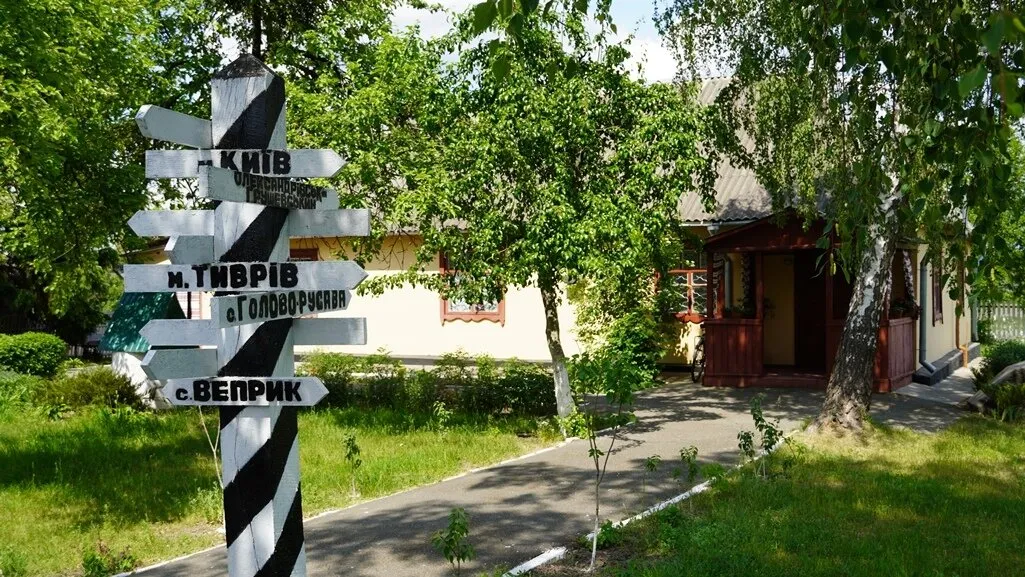
Getting to know the museum begins in the cosy yard of the homestead, wrapped in the branches of fruit trees and a spreading red viburnum.
A true adornment of the museum’s exterior is the high relief of K. H. Stetsenko, installed for the 110th anniversary of the composer’s birth (by A. A. Drevetskyi).
Through a small porch we enter an unusual place, the kitchen of a Ukrainian house of the early 20th century. Opposite the door is a whitewashed stove with a sleeping ledge and all kinds of kitchen utensils: pokers, stove rakes, pots and bowls. There is an old sideboard and a dish rack with crockery from the early last century, and a big homemade table around which a sizeable family used to gather; in the place of honour hangs the icon of the Holy Martyr Paraskeva.
The kitchen’s arrangement, furniture, crockery, various agricultural tools and the embroidered towels on the portraits create the unique atmosphere of a completely different, somehow unreal world. It was in just such a room that Kyrylo Hryhorovych once taught village children musical notation by the flickering light of an oil lamp.
The exhibition continues in the living room, a cosy room with a large black grand piano. Behind the display glass are photographs that tell about Kyrylo’s first steps in life.
Further on, the exhibition presents Kyrylo Hryhorovych’s difficult life path: work in Kyiv, Bila Tserkva, Tyviv and Holovo-Rusava. The composer’s creative output in these periods is confirmed by the publications presented in the exhibition.
Above the piano are portraits of prominent figures of Ukrainian culture of the late 19th and early 20th centuries: M. V. Lysenko, K. H. Stetsenko, M. D. Leontovych, Ya. S. Stepovyi, O. M. Kovalenko and others.
A large portrait of the composer, painted by an unknown author, is striking. In it Kyrylo Hryhorovych is depicted in one of the happiest periods, when he lived and worked in Kyiv.
The tour continues in the next room, whose exhibition tells about the Kyiv period in the composer’s life: the revolutionary events, his enormous creative work in building the Ukrainian state, and the creation of the Ukrainian Republican Choir, two touring choirs, a symphony orchestra, a music publishing house and a sheet-music library.
This hall also covers K. H. Stetsenko’s Veprik period; photographs show the activity of the villagers in the “Prosvita” society, amateur art circles and other important historical events of the village. One section of the exhibition acquaints visitors with the preservation of the memory of Kyrylo Hryhorovych, the present-day achievements of Stetsenko studies, rare printed editions of the composer’s works, and books about him by well-known writers and art historians.
The sculptural image of K. Stetsenko (by M. A. Dmytriv) draws attention; it fits organically into the exhibition and vividly conveys the composer’s creative charisma.
The exhibition continues in the bedroom, where the everyday life of the Ukrainian rural intelligentsia of the 1920s is recreated in detail. The interior includes a round table with an openwork tablecloth, a kerosene lamp, old chairs, beds covered with simple homespun blankets, and a chest and icons which, according to tradition, belonged to the Stetsenko family. The interior is complemented by a model of the composer’s homestead in the village of Veprik.
The exhibition concludes with photographs of Kyrylo Hryhorovych’s relatives, who chose the beautiful and thorny path of continuing the work of their grandfather and great-grandfather.
A separate room houses an exhibition that introduces visitors to the life and work of the museum’s founder, the fiery poet, patriot, public figure and paramedic of the local first-aid and obstetric station, V. I. Kosovskyi.

More articles