The Khoietsky Estate — An Architectural Discovery of the Fastiv District
The Khoietsky Estate is one of the few manor residences of the Kyiv region to have survived the turbulent 20th century and still impresses with its architecture. Located in the village of Tomashivka, this palace and park complex remains among the most interesting locations in the Fastiv district. The Khoietsky Estate was built between 1903 and 1910 for a family of Polish nobility. The project was designed by architect Valerian Kulikovsky, who combined elements of Art Nouveau and Neo-Gothic in the building. Thanks to its turrets, balconies, verandas, and decorative elements, the palace has a distinctive silhouette — unlike typical country residences. Among other estates of the Kyiv region, this complex stands out not only for its architecture, but also for the fact that it has been preserved to the present day. At one point this early 20th-century estate was in a neglected state, but from the 2000s it began to be restored. Today the complex is part of a men's monastery, and the grounds are well-kept and open for walks. A park with flower beds, sculptures, gazebos, ostriches, peacocks, and ponies makes the estate particularly interesting for families with children. The monastery is open daily from seven in the morning to eight in the evening. Admission is free, however visitors are asked to observe a dress code and to coordinate photography with the brotherhood.
The Mammoth Memorial — The Most Unexpected Monument of the Fastiv District
Taking a photo with a mammoth sounds fantastic, but for the Fastiv district nothing is impossible. In 1947, during construction work in the village of Hatne, an almost complete mammoth skeleton approximately 3.5 metres tall was discovered. This sensational find is now on display at the National Museum of Natural History in the capital. It is commemorated by a themed sculpture "Generation," created by Kyiv architect Vlad Holdakovsky. It is located in the village of Hatne on a landscaped area near a local shopping and entertainment centre. The Mammoth Memorial of the Fastiv district is a unique palaeontological monument of the Kyiv region, with no equivalent in other communities of the region. This location is sure to delight young travellers. And for adults, it will serve as a reminder that sometimes the most interesting discoveries are waiting right nearby.
What Else to See in the Fastiv District
The Kovana Skarbnytsya Blacksmithing Museum
Not every museum can boast the Terminator, Bumblebee the Transformer, and other fantastical characters in a single exhibition. The "Kovana Skarbnytsya" in the village of Kapitanivka in the Fastiv district is a blacksmithing museum with unique handcrafted works and one of the few museums of this kind in the Kyiv region. Masterclasses are also held here, so getting to know the craft is not limited to viewing the exhibits.
The Church of the Exaltation of the Holy Cross in Fastiv
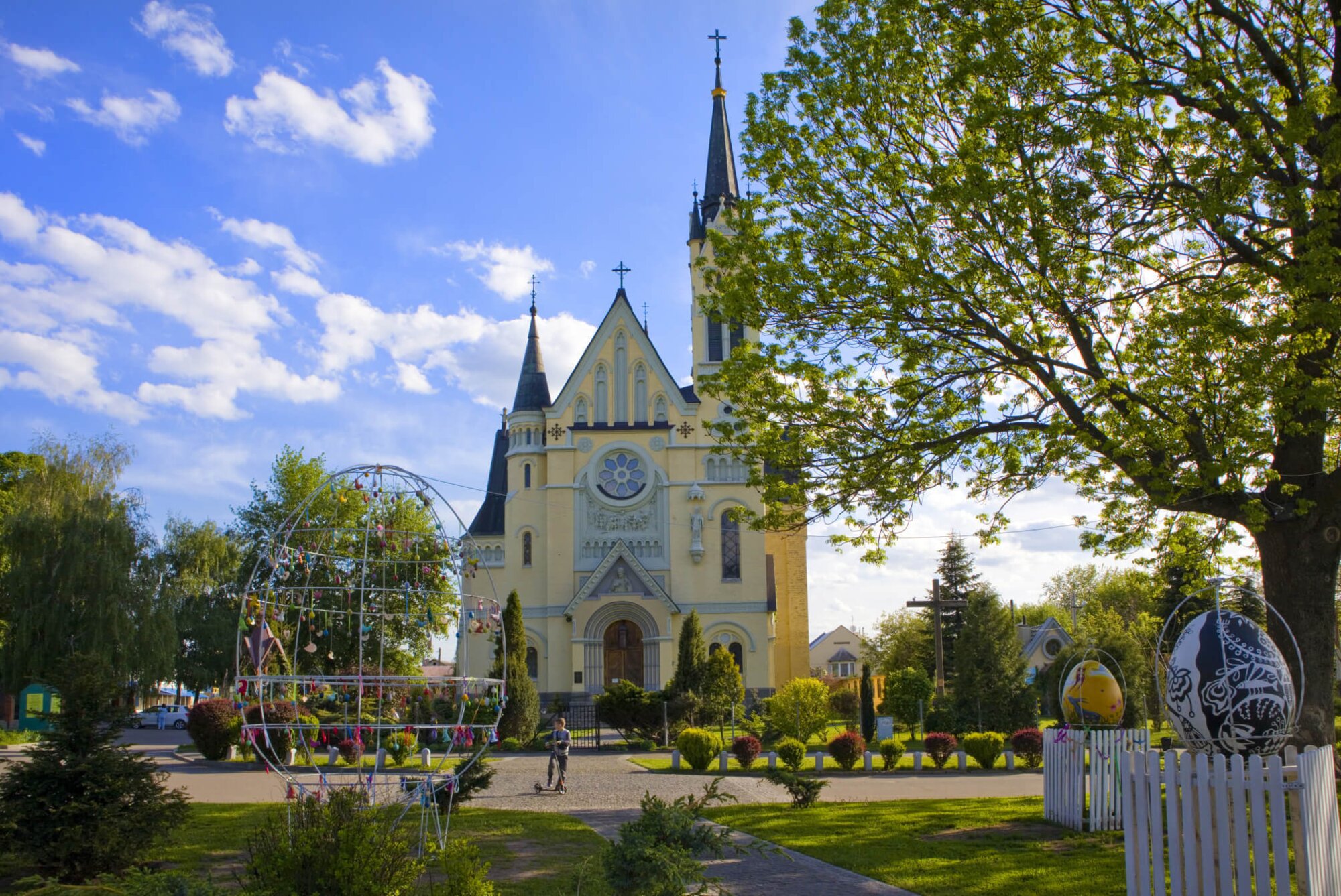
The church does not have two identical towers — its southern tower is almost twice as tall as the northern one. The asymmetry is echoed in other details of the façade, making the church one of the most original architectural monuments of the Kyiv region. The church was built between 1903 and 1911 in the Neo-Gothic style. Today it is one of the few historic Catholic buildings in this part of the region and one of the main architectural calling cards of Fastiv.
Molodizhnyi Arboretum
The park is located on the high bank of the Unava River, and its grounds are crossed by picturesque slopes and ravines. The Molodizhnyi Arboretum in Fastiv brings together over a hundred species of trees and shrubs, including those listed in the Red Book of Ukraine. It is a great location for family recreation, a romantic date, or a photo session.
Perepiat Burial Mound
It is mentioned in chronicles, and in the mid-19th century Taras Shevchenko sketched it during an archaeological expedition. The Perepiat Burial Mound in the Fastiv district is one of the largest Bronze Age burial mounds in the Kyiv region, attesting to the settlement of these lands as far back as the 2nd millennium BC. At one time it reached approximately 11 metres in height and was among the largest archaeological monuments in this part of the region.
Mlynok Farmstead
The modern farmstead stands on the site of one of the largest ancient settlements of the Kyiv region. In the 6th–5th centuries BC, the fortified settlement covered approximately 40 hectares and was surrounded by ramparts, ditches, and natural water barriers. Today, the remains of the fortifications and a landscape that has almost retained its natural character serve as reminders of the ancient history of the place. The Fastiv district has preserved many traces of different eras. Equally interesting is the Cossack heritage of the Kyiv region, connected to the name of Semen Paliy.
Fastiv and the Cossack Heritage
Fastiv is connected to the name of Semen Paliy — a Cossack colonel of the early 18th century who made the city one of the centres of Cossack resistance on the Right Bank. Today, the Cossack heritage of Fastiv makes itself known through the oak tree of Semen Paliy in the Unava tract. According to legend, it was the Cossack colonel himself who planted this tree, which is now over 350 years old. Its girth reaches approximately four metres, and since 1972 the oak has been under state protection. This page of history is further complemented by the exhibition at the local history museum and the numerous mentions of Semen Paliy that have survived to the present day.
How to Get There and Which Route to Choose
The Fastiv district is located 60–80 km from Kyiv. The most convenient way is to travel by car along the Zhytomyr highway E40 — the journey takes about an hour. For a one-day trip, we recommend beginning the route at the Khoietsky Estate in Tomashivka. Next, it is worth visiting the chronicle Perepiat Burial Mound near Fastivets, the Church of the Exaltation of the Holy Cross, and the Molodizhnyi Arboretum in Fastiv. On the way back to Kyiv, you can stop by the Kована Skarbnytsya Blacksmithing Museum in Kapitanivka and finish the journey at the Mammoth Memorial in Hatne. Such a route through the Fastiv district allows you to see architecture, archaeology, Cossack history, and unusual museum locations in a single day. This is a good option for those planning a meaningful weekend from Kyiv.
Plan Your Trip to the Fastiv District
Save this Fastiv district route for your next weekend and explore the district at your own pace. If you are looking for even more travel ideas, browse the tourist map of the Kyiv region and the general events calendar for the region. There you can find new routes, interesting locations, cultural events, and recreation options for those interested in Fastiv, tourism, and weekend travel.