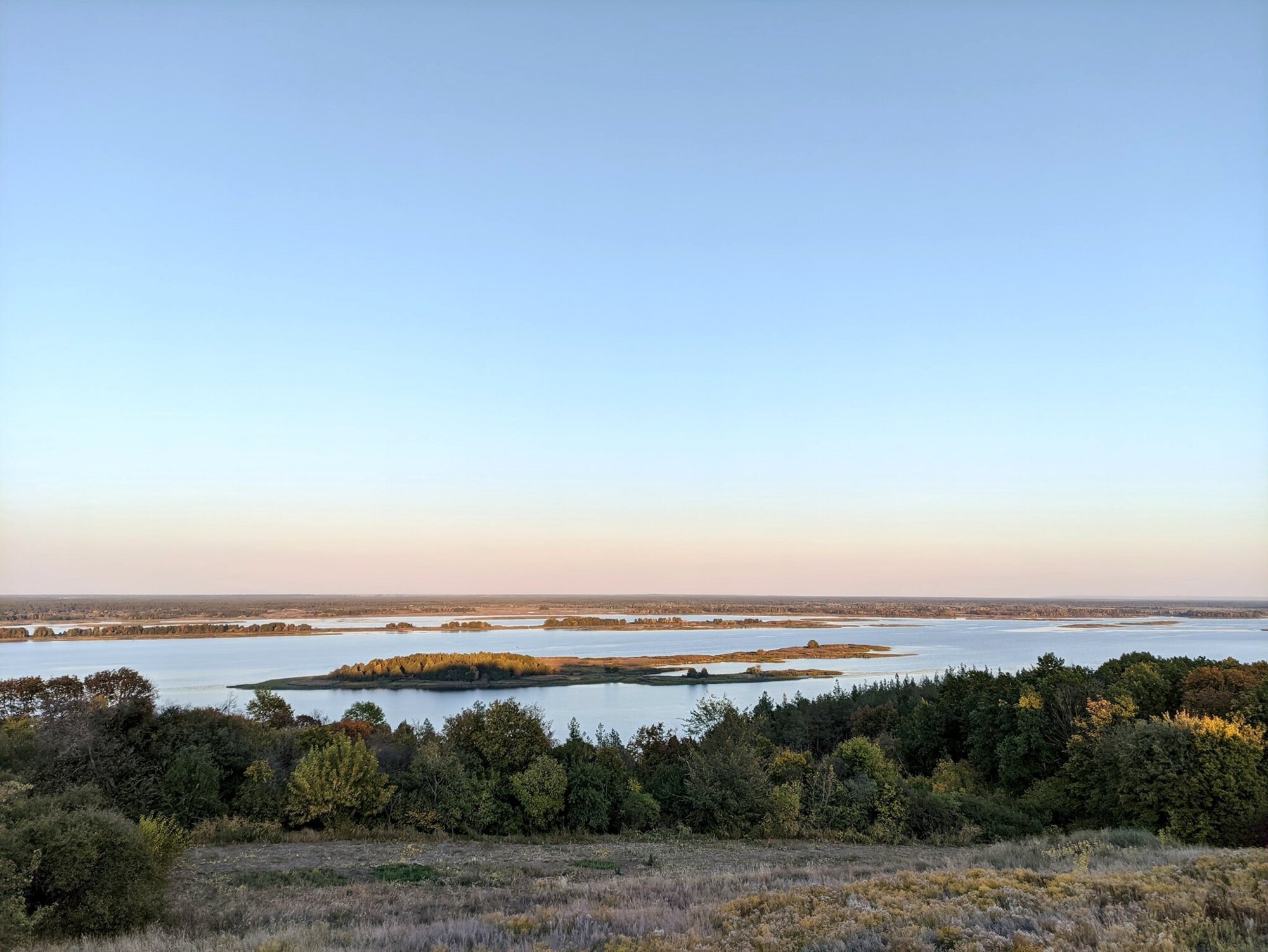
Krasukha Mountain is located in the village of Vytachiv, not far from Trypillia. Paradoxically, the fate of Vytachiv is similar to that of other villages of the Obukhiv district (and not only this one) of Kyiv Oblast. It concerns the course of settlement of various territories near Kyiv. In this respect it is interesting that most of them, including Trepol, Khalep, Krasin and Vytachiv itself – known in history first as Novgorod-Sviatopolchyi and then Vytychiv – appeared as Dnipro fortress-towns.
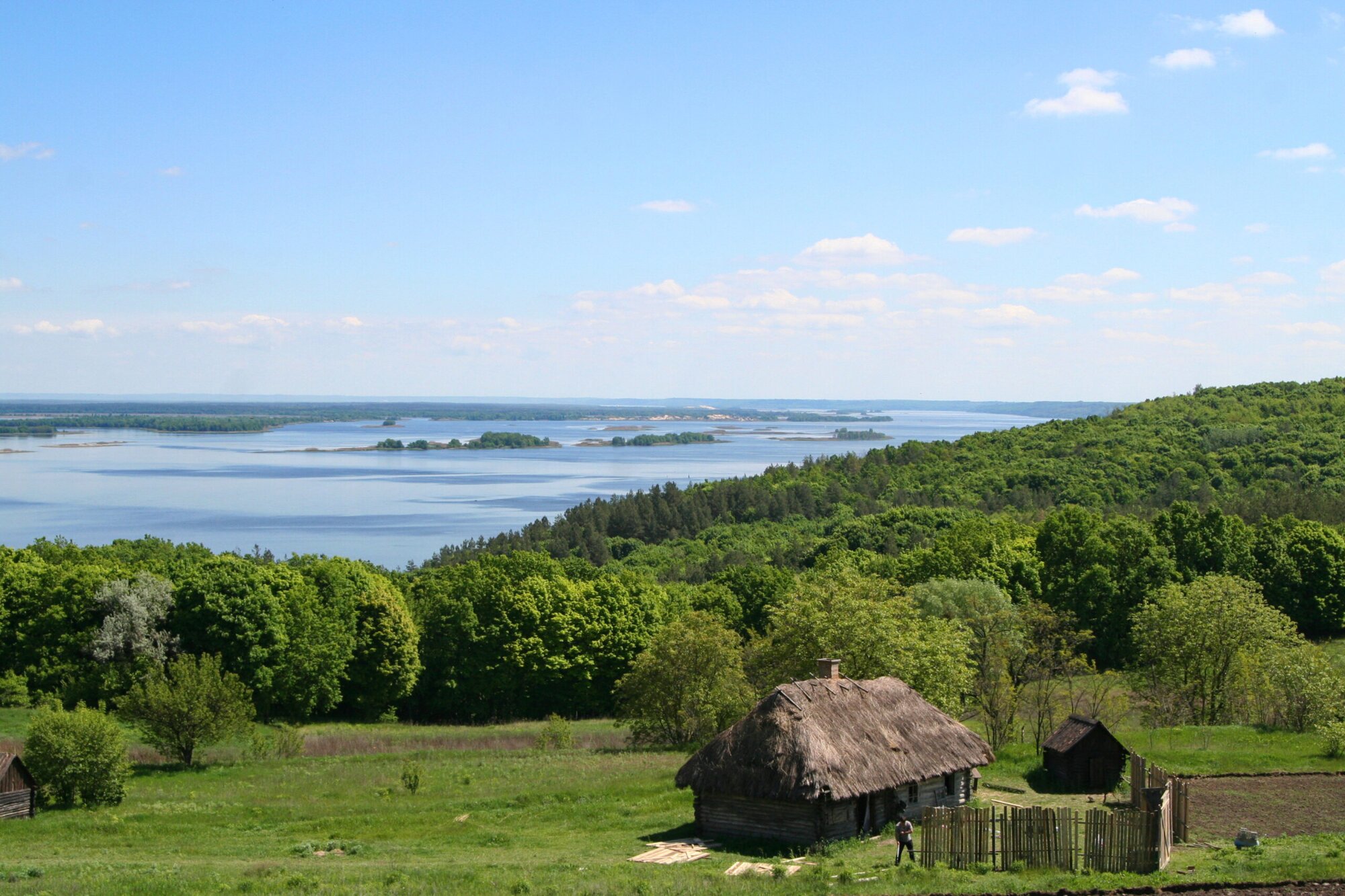
Now these are small pastoral villages, sunk in the greenery of hills above the water, which lure rural romantics – from eco-settlers to VIPs. Fortunately, the landscape, cut by ravines and gullies, does not allow would-be developers to build up the very steep coastal strip overgrown with forests and shrubs.
“In the summer of 382, the Great Prince of Kyiv Velimir passed away, and his eldest son Danko took the throne, and sat in the city of Vytychiv, and began to rule the Rus over the Derevlians, and the Siverian Meadows, and the Goths and all the tongues that paid him tribute, and went to war with the Great Prince, and glorified him (Ivan Bilyk, ‘The Sword of Arey’).”
The creative imagination of the famous Ukrainian writer takes us to princely Vytachiv, which the young Bohdanko chose as the capital city of Rus after his father’s death, more than one and a half thousand years ago.
The Obukhiv local historian Yu. Domotenko writes in his book “1000-year-old Vytachiv”: “Researchers of antiquity believe that Roden, the first capital of our people (not to be confused with Rodnia, which existed as late as the 11th century on the Ros River – author’s note), was located somewhere in this area.” Here “monuments of all the archaeological epochs that human civilisation has lived through in Ukraine have been found.”
Vytachiv, Vytechiv, Vytechev, Vitichev, Vytachev, Vitachov, Ouvhtychi – Uvetychi, – Vytchevh Kholmh (Old Rus), Vytakholm, – Vitagolm (Varangian), Vantit, – Vabnit (Arabic), Vytetchevo (Greek), Vitapolis, Vytych… One of the popular versions of the origin of the name explains that the Dnipro makes two bends at this place (left and right), so this stretch of the Right Bank seems to “protrude” from the river, dominating the surroundings from its height for many kilometres.
Like most Dnipro-side settlements, the “Vytachiv cluster” includes several sites separated by centuries, among which the best known are the ramparts of Novgorod-Sviatopolchyi. Besides them, near the village there are Bronze Age settlements and Scythian necropolises, Old Rus hillforts and medieval religious buildings. This continuum, regardless of possible discontinuity, testifies to the permanent habitation of the area by various peoples.
Of course, Vytachiv is not the heart of the first Aryans, whom, according to Ihor Kahanets, the epic Rama once brought to the Dnipro shores. Yet Vytachiv, like most of the strip adjacent to the Dnipro, is too convenient for living to be neglected. Therefore people lived here, various and different.
Vytachiv has outlived, like no other, representatives of various archaeological cultures, among which it is worth noting the Bilohrudivka culture (11th–9th centuries BC), the Dnipro-Donets culture (5th–3rd millennium BC), and cultures of the beginning of our era: the Zarubyntsi and Chernyakhiv cultures and others.
According to V.B. Antonovych’s “Archaeological Map of Kyiv Province”, there were about 10 burial mounds near the village.
Officially, the first of them was excavated by M.Ye. Brandenburg back in 1891. Strangely, it turned out to have been plundered already.
Vytachiv was also famous for finds of ancient hoards of coins. In particular, in 1858 a hoard of 877 silver Arab dirhams was found, which at that time served as international money, just as the US dollar does today. In 1875 a large hoard of such coins was found again – about 905 pieces. In the opinion of many modern historians and numismatists, such large hoards of dirhams may indicate that pagan sanctuaries were located nearby.
The modern sacred topography of Vytachiv differs from the historical examples mentioned above. Unfortunately, today nobody performs rites on the burial mounds beside the village or lights fires on the hills above the Dnipro.
Every era leaves its own traces, which today show all the signs of late New Age, or simply put, neo-cult. A notable role in shaping it was played by the outstanding Ukrainian science-fiction writer and humanist Oles Berdnyk, who lived for some time on the Dnipro bank in Vytachiv.
Besides a clear civic position, which ultimately determined his status as a dissident, Berdnyk was the founder of the Ukrainian Spiritual Republic – a romantic organisation whose ideas insist on the primacy of the spirit and direct the edge of human progress forward, to cosmic horizons.
As for modern place names, they can conditionally be divided into two parts. The first is Kniazhyi Shpyl (Prince’s Spire), a place familiar to most who have visited Vytachiv. It is where the chapel built by Berdnyk stands, in which until recently pagan calendars lived peacefully alongside Orthodox icons.
According to a local legend – and legends here, it should be noted, are strung along the thread of time like nowhere else – the chapel was built from a sketch by T. Shevchenko. He, in turn, drew it from an old Cossack chapel with crosses on both sides. Built at the dawn of Independence (1991), it stands on the place where, it is supposed, a congress of princes took place on 30 August 1100.
There are essentially two crosses. The first is on the chapel, seven-rayed, multiplied by a crescent, also authored by the Kobzar, whose connections with the Masonic lodges of the time still interest historians.
The second, metallic, stands on the place where the Apostle Andrew allegedly planted it in the 40s AD while heading to the Kyiv hills, which is why this cross claims the title of the “first cross in Rus”. Of course, this story is no more than a fairy tale. Obviously, the biography of the Apostle Andrew – the first disciple of Christ, who gave up fishing to spread the Teaching – contains too many ambiguous moments to take seriously his ability to visit a vast number of the countries of that time in a short period.
Without a car, train, plane or security. With a serious, undiplomatic educational mission. Whatever the case, the concentration of sites on Kniazhyi Shpyl is quite dense. Right behind the chapel, beside the cross, is a place considered the mass grave of those killed during the invasion of Batu’s hordes. According to one version they were local residents, according to another – the Novgorod militia.
The second place that attracts esotericists and lovers of the paranormal no less is Mount Krasukha, known for lights above its summit. In principle, there is nothing surprising in this, given that it was evidently here that the Vikings, who gave the village its name, lit their fires (from the Scandinavian “vitahelm” – fire on a hill). Later, in the area of Molodetska Gully, the fires of a Perun sanctuary burned on it, and then the candles of an Orthodox hermitage. Now they are lit in a small cemetery that has replaced the mentioned sites.
In general, Krasukha and Kniazhyi Shpyl fit organically into the concept of so-called “paired mountains”, which unite the “male” and “female” principles. There are quite a few such examples in Ukraine, for instance Babyn and Didiv Shpyl near Trakhtemyriv, and so on.
“One of the most mysterious places in Vytachiv is Mount Krasukha, on whose summit we are now standing. Here, at the pagan sanctuary of the god Perun, a fire burned day and night, seeing our ancestors off on distant campaigns and being the first to greet them in their native land” (from the stories of tour guides on tourist routes).
“And what makes it so mysterious?” one of them was asked. “Who knows. But I, and my colleagues, and many people who have been here, assert: you can feel Something here, unusual, unfamiliar, but not frightening or alarming – on the contrary, uplifting and calming, distant and… dear! Very unexpected feelings… Just listen to the name itself: not Lysa (Bald), not Vidmyna (Witch’s), but Krasukha. Something calm, warm and cosy comes from it; it sounds like a synonym for a gentle fair morning or a clear sunny day from far-off barefoot childhood.”
Indeed, quite strange events (interestingly, nobody associates them with a negative background, as, for example, with the notorious Molodetska Gully), from the point of view of us modern people and “bioenergetic neophytes”, regularly occur on Krasukha even now.
Some researchers claim that Krasukha is one of the most powerful positive energy points on the planet. No wonder people are so drawn here… Here the soul truly calms down and rests – you do not want to leave!