Foreigners on Ukraine in the 16th Century
The emergence of the Ukrainian Cossacks and the creation of the Zaporozhian Sich caused not only resistance to the policy of expansion onto Ukrainian lands by neighbouring states, but also the growth of national consciousness, the activation of the national liberation movement and the unfolding of state-building processes. This, of course, attracted the attention of neighbouring states, whose representatives perhaps discovered Ukraine anew – the heir to the Old Rus glory of Volodymyr and Yaroslav – as a Cossack land, the homeland of a courageous and hospitable people.
From the history of Ukraine in the 16th–17th centuries there is a considerable number of memoirs written by foreigners. This is a special kind of literature in which travellers recorded unusual, colourful episodes of the life of the people, their customs and character, and described the cultural achievements that impressed them.
One of the most interesting works of the end of the 16th century is the diary of the diplomat of the German emperor Rudolf II, Erich Lassota, which reflects foreigners’ thoughts about Ukraine, its social relations and its people. In 1594, on the instructions of Rudolf II, Lassota arrived at the Zaporozhian Sich to persuade the Cossacks to enter imperial service to fight against the Turks. Throughout the summer the Zaporozhians dragged out negotiations with various promises and finally refused. But Lassota became thoroughly acquainted with Ukraine and its people, gave information about the first years of the formation and heroic activity of the Zaporozhian Sich, and left descriptions of Ukraine.
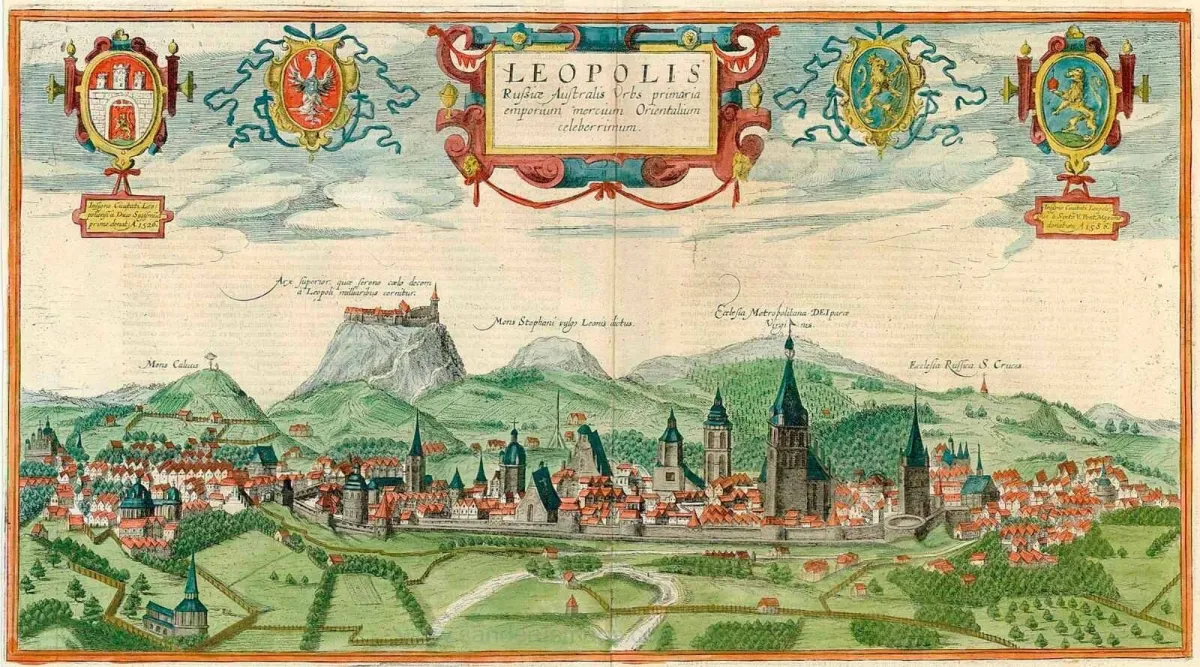
Among the cities of Ukraine, fortified and quite developed for those times, E. Lassota mentions Lviv – the capital of Red Rus – and Kamianets in Podillia. The cities had their own episcopal sees, voivodeships, starostvos and fortified castles – two in Lviv (one in the city and one beyond it on a high hill with a magnificent view for several miles), while in Kamianets the castle was connected to the city by a high bridge; besides, the city was distinguished by strong natural defences, which made it unique even compared with the cities of Poland. Lviv became famous for its developed trade, conducted mainly by Armenians, who had their own beautiful church. The diplomat’s attention was also drawn to the large (4,000 houses), new fortified town of Pryluky – with a castle, surrounded by fertile fields and pastures, among which scattered single small houses with loopholes were astonishing, where peasants hid during Tatar raids. Because of the constant Tatar threat, every peasant going to the field always had a weapon with him (a gun, sabre or cleaver).
E. Lassota describes Kyiv as the former glorious capital of an independent principality – a large and fortified city with a great number of beautiful churches, public and private buildings. Among them particularly famous and majestic is the Cathedral of St Sophia, which has no equal in size, built by Prince Volodymyr after the model of St Sophia in Constantinople. The diplomat admires the architectural and artistic appearance of the church: mosaic on the vaults, a floor laid with coloured stones, upper galleries framed by railings of blue-stone slabs with openwork carving, a spiral staircase leading to the tower, in which, according to legend, Volodymyr convened the Council – a light, bright room that was called the “capital of Volodymyr”. At the same time E. Lassota notes the great neglect of the church, which nevertheless preserved its former grandeur.
The traveller was also impressed by the Golden-Domed Church of St Michael: a beautiful building with a rounded gilded dome, whose walls are decorated with mosaic and whose floor is laid with small coloured pebbles. Lassota is also captivated by the Pechersk Monastery with its wonderful brick church.
E. Lassota noted a certain desolation and substantial destruction of old Kyiv and the building down in the valley, on the right bank of the Dnipro, of the modern city, which occupied quite a large area, over which houses with small gardens were spread, with many wooden churches (only one of stone, on the square). High up on a separate hill stood a wooden castle plastered with clay, occupying a large space. The presence in the city of a Catholic bishop’s see and a cathedral church (though completely neglected and wooden), and the existence of a not very wealthy Armenian community with its church, testifies to the multi-confessional character and ethnic tolerance of Ukraine.
During his stay at the Zaporozhian Sich, E. Lassota was struck by the high level of good manners of the Zaporozhian officers and their good knowledge of the peculiarities of European diplomatic relations. On arrival at the island of Bazavluk, the Zaporozhian officers met the diplomat with honours: they sent out an escort to meet him and fired cannons in honour of the ambassador. The next day the Zaporozhian hetman with several officers paid a visit to the ambassador and then received him at his place. During the audience all the subtleties of diplomatic reception etiquette were observed, which greatly surprised E. Lassota, as did the officers’ knowledge of the policies of neighbouring countries, and of the nuances and intrigues of the political realities of the time. At the same time the Cossacks remarked that it was not their custom to enter service and go on campaign under uncertain conditions, and therefore they wished an official treaty to be signed.
Interesting information is given in the memoirs about the Muscovite envoy, whom foreign authors of that time often characterised as deceitful and cunning. And this time, before the German diplomat, the Muscovite envoy presented himself as the patron of the Zaporozhians, who supposedly were in the service of the Muscovite prince, while in fact he had come to Zaporizhzhia as a petitioner and observer.
Lassota characterised the Zaporozhians as brave and enterprising people who from childhood trained in military affairs, knew the enemy (Turks and Tatars) perfectly, had their own cannons, and many of them knew how to handle these weapons, so there was no need to keep separate gunners (as was customary in the German army); their officers were content with the common ration, not demanding greater pay.
At the end of his account E. Lassota concluded that the Zaporozhian Cossacks enjoyed enormous influence not only in Ukraine, all of Poland looked to them, and its internal affairs were not very stable. Gaining the friendship of the Ukrainian Cossacks seemed to the German diplomat an important matter.
Oksana Tarapon,
Candidate of Historical Sciences, Associate Professor,
Leading Researcher at the Research Department
of Historical Local Studies, Pereiaslav National Historical and Ethnographic Reserve


More articles