THE CRADLE
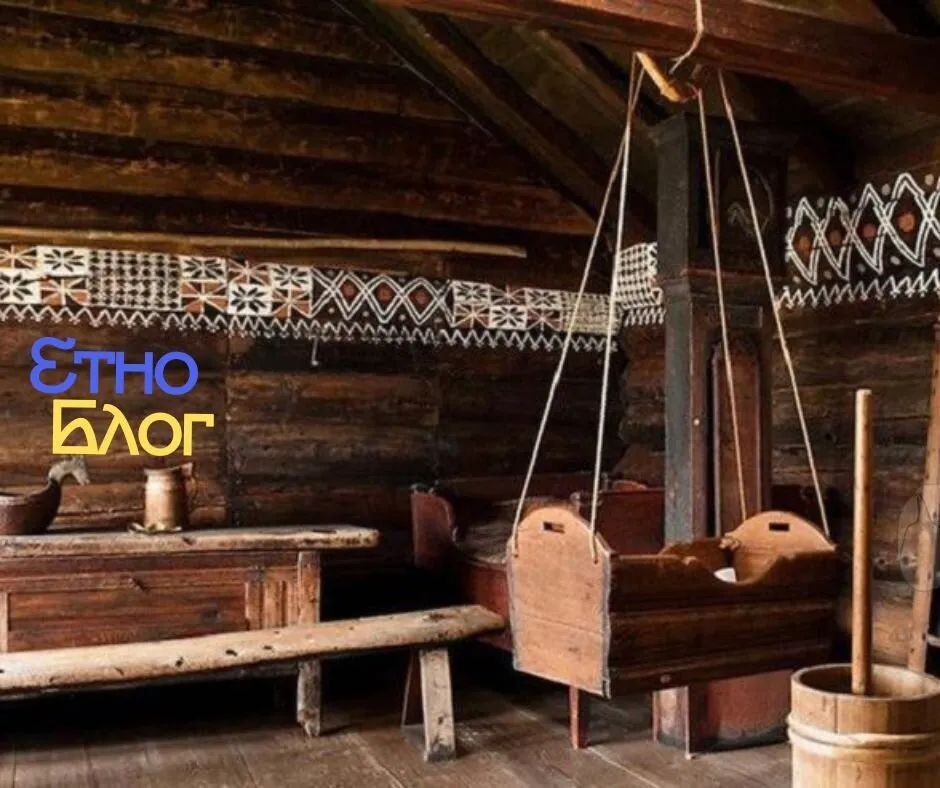
The cradle (“liulka”, “liulia”, “kolybka”, “baiukalka”, “hoidalka”) has long been an important attribute of Ukrainians’ living space – a traditional “little bed” for a child to sleep in and be rocked. Its absence made a home forlorn and unhappy: “What kind of family is it if there is no cradle in the house.”
In Ukraine, hanging cradles were mostly used, which was linked to practical considerations (warm air rises) and to religious beliefs that in such a little bed the child is under the protection of heavenly powers. Cradles were made from available materials: wood, willow twigs, ropes, leather, linen, straw. Depending on shape, material and construction, they are divided into types: frame, woven, plank and dugout. A cradle was made only from “clean” deciduous trees (maple, sycamore, viburnum, ash, hazel, walnut). For girls the cradle was made from a “female” tree, for boys, accordingly, a “male” one. Making the cradle was entrusted only to the closest relatives – father, grandfather, uncle, godfather – those who were trusted and believed to have positive energy. More complex types of cradles were ordered from craftsmen who necessarily had a kind heart, a good reputation and a suitable family status (not divorced, good family men).
The traditional Ukrainian cradle looked like a box. The sides (the frame) were called “bylts”. Four ropes (“vervechky”) were tied to the corners of the hanging cradle, by which it was hung from a hook or a ring fixed to the ceiling beam (“svolok”). A cord, the “pochipka”, was tied to the side, and the mother put the loop at its free end on her foot to rock the cradle.
There was always one cradle in a family, and it could serve many generations for up to 200 years. Lucky cradles in which a baby grew up healthy and calm were valued and passed down as an inheritance. If a child died, no more infants were put in that cradle, and it was taken to the forest. If infants grew up safely, the cradle was considered lucky and was kept for the next children. Until the next child was born, a doll took the cradle’s place and guarded it from evil spirits. If the couple were no longer able to have children, the cradle was carried up to the attic. Destroying it was forbidden – “then there will be no children in the family line”. If a young couple had no children, they went to visit a new mother to rock the cradle with her child. A cradle unfit for use was left in the forest, in a tree.
The cradle had not only a utilitarian but also a sacred meaning. To keep evil spirits from touching the child, amulets were placed in the cradle: the chest cross received at baptism, icons, consecrated herbs, willow twigs, garlic, a crust of bread, a thistle flower, amber. Sharp and cutting objects were placed under the cradle: scissors, knives, a comb. Straw was laid on the bottom of the cradle: wheat for a daughter, rye for a son. Thyme, immortelle, mint and hop cones were put under the pillow so the child would sleep better. A canopy was a mandatory attribute of the cradle. It protected the baby from mosquitoes, flies, light and evil spirits.
A string of ritual actions and beliefs is connected with the cradle. It was forbidden to rock an empty cradle; the child would not be able to sleep peacefully in it. It must not be rocked by two people, as this could cause a quarrel in the family. One must not sit with one’s back to the cradle. It must not be left in the yard after sunset. It was positioned so that the baby slept with its feet towards the door and its head towards the sunrise. The cradle was carried out of the house only head first. The cradle with a child in it was not passed across the threshold. On the third day after the child’s birth the ritual placing of the baby in the cradle took place. By that time the child had to be baptised. Before putting the infant in the cradle, a motanka doll or a wooden block was put in to “spend the night” so that everything evil and unclean that might be in the cradle would pass to them. Often a cat was the first to be rocked, with the words: “As for the purring cat, so for the child, drowsiness.” It was believed that the cat could give the child a calm temperament and bring sweet sleep. Rocking the child was always accompanied by a lullaby, which served as a verbal amulet.
Cradles that have come down to us from past centuries are a wonderful creation, a family relic and a national symbol that ensured the preservation of traditions and the continuity of generations. The collection of the Pereiaslav National Historical and Ethnographic Reserve holds 25 cradles of various designs (house and field), dating from the early 19th to the mid-20th century.
Olena Zham,
Leading Researcher at the Bread Museum of the Research Branch “Museum of Folk Architecture and Life of the Middle Dnipro Region” of the Pereiaslav National Historical and Ethnographic Reserve




More articles