Rites of the Green Holidays (Trinity)
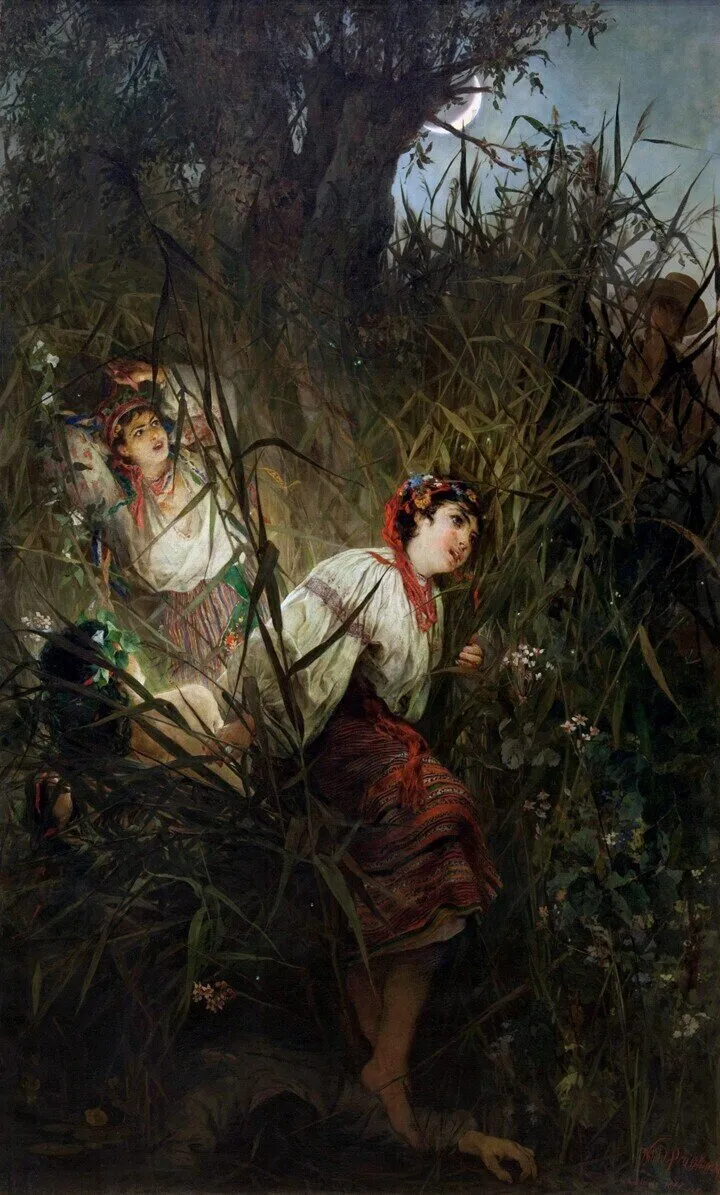
The rites of the Green Holidays marked the end of the spring cycle and the beginning of the summer one in the calendar: “the end of spring meets the beginning of summer”.
Green Sunday, which falls on 4 June this year, is the most poetic holiday, closely tied to nature. Today it is part of the Christian feast of Trinity. In pre-Christian times it was an entirely separate holiday that lasted a whole week. It began on a Thursday (in the seventh week after Easter; this day was also called Semyk) and ended on the following Thursday, known as Rusalnyi Velykden (Rusalka Easter). In other words, it was a whole complex of rituals aimed at the growth of plants and the coming harvest.
At its core, this is a holiday of ancestors, a time of honouring the dead. Accordingly, all the rites and rituals of these days were meant to summon the souls of the dead from the other world and honour them, as well as the spirits (minor deities such as rusalkas, mavkas and others). They were supposed to help those who still tend the land to grow a good harvest, for it is at this very time that rye blossoms and orchard fruit and garden vegetables ripen. So that evil, dark forces would not slip in along with the good ones, and to protect themselves from them, in other words from the influence of negative energy, people used protective herbs. Especially noteworthy is the aspen bough: it is placed on gates and in the corners of the cattle shed to protect the livestock from witches. This tree has a special power to counter evil spirits. For the same purpose wormwood is used, as a protection against rusalkas, who come out of their waters onto dry land on this night.
At Semyk, girls held festivities and braided a birch tree. The Trinity wreaths they wove on the birch marked the transition of spring into summer. At the beginning of summer a Trinity wreath is woven from birch, then a Kupala wreath of flowers and, finally, a harvest wreath of rye or wheat. In the same way, the periwinkle or rue wreath that is woven for the bride before the wedding crown seems to complete her maidenhood, the spring of her life. The custom of braiding the birch was widespread in the north and east of Ukraine. In its central part, on these days girls carried a small tree decorated with wreaths and ribbons. In the Poltava region they led around a “poplar”, and in Polissia a “bush” (kusta).
Perhaps the most colourful element of these holidays in the villages along the Dnipro is the vikha. The idea of the vikha is a temporary chapel and a sign of the sun; it is both a sacred tree and a sign of energy. It is an antenna between the earth and the cosmos, an energy corridor for energy exchange. A vikha was put up in every corner of the village and had to be taken down on the third day; otherwise those who put it up, that is, the young people of the village, would begin to die. The grass from the vikha was not thrown away: it had magical power, so it was fed to the cattle. It usually rained on these days.
Here is how M. Maksymovych recalls the vikha: “In Ukraine the lads put up a ritual oak: this is the name for a long pole with a wheel fixed at the top, which is entirely decked with grass and flowers. The housewives, knowing that their vegetable gardens will be plundered, keep watch over them; but the whole point of the lads’ prowess is to steal flowers where they are guarded. The girls help the lads decorate the alluring wheel with flowers and ribbons, under which a communal celebration will be held during the first days of the Green Week. The ritual “oak” is put up on the Saturday before Whitsun on the common pasture or the village square. A small ditch is dug around it, and in some places birch boughs are also placed all around. In the village of Rohoziv this pole with a wheel is called a dry oak, and they sing:
Unfurl, dry oak, for the frost will come for you!
I am not afraid of the frost, spring will come and I will unfurl!”
In the Pereiaslav region, Rusalnyi Velykden (the Thursday of the eighth week) was called Dry Thursday. On this day it was forbidden to disturb the earth, for there would be a great drought. Instead, Ukrainians dried their clothes. On the Right Bank they saw off the rusalkas, all those who had been invited to earth. In Polissia people went to the cemetery and carried boughs, hot pies and boiled eggs. Swimming during the Green Holidays is not allowed.
Senior Researcher of the Museum of Ukrainian Rites
of the Pereiaslav National Historical and Ethnographic Reserve
Svitlana Zuber

More articles