Awaiting the Bright Resurrection of Christ
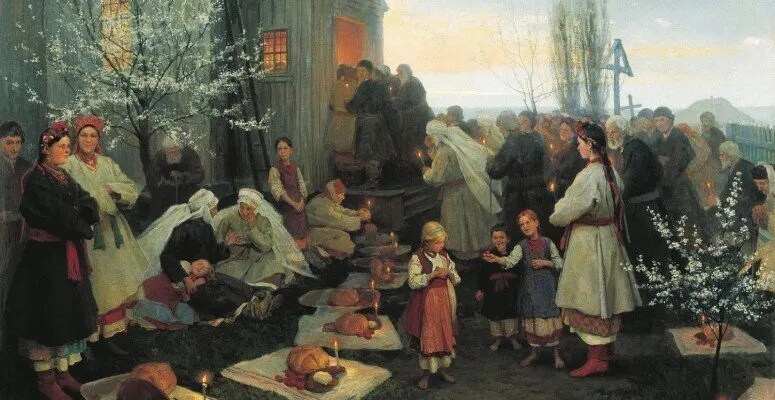
In the imagination of our ancestors, Easter was a feast of the complete victory of warmth over cold, of life over death.
The feast of the Resurrection of Christ, one of the greatest feasts of the year, is characterised by exceptionally long preparations. On the last Sunday of Great Lent the church celebrates the solemn Entry of Jesus Christ into Jerusalem, called Palm (Willow) Sunday among the people. Children awaited these days with particular impatience, because it was their holiday. On Lazarus Saturday village teenagers went to the edge of the forest to gather willow twigs and bring them to church, where the willow was blessed. Blessed willow has magical power: it was used to drive livestock to pasture for the first time so that evil spirits would not cling to them, and thrown into the yard during hail so that the hail would stop. Mothers “blessed” their children with willow branches. The rite of symbolic striking had magical power. By it people tried to convey to the children wishes of tall growth, strong health and abundant wealth:
“Willow, lash, beat till tears, it is not I who beat, the willow beats,
A week till Easter, not far off is the red egg:
Be healthy as water, tall as the willow, and rich as the earth!”
During Willow Week, according to folk belief, nothing should be planted or sown, because “it will grow lush and wild and be bast-like, like willow”.
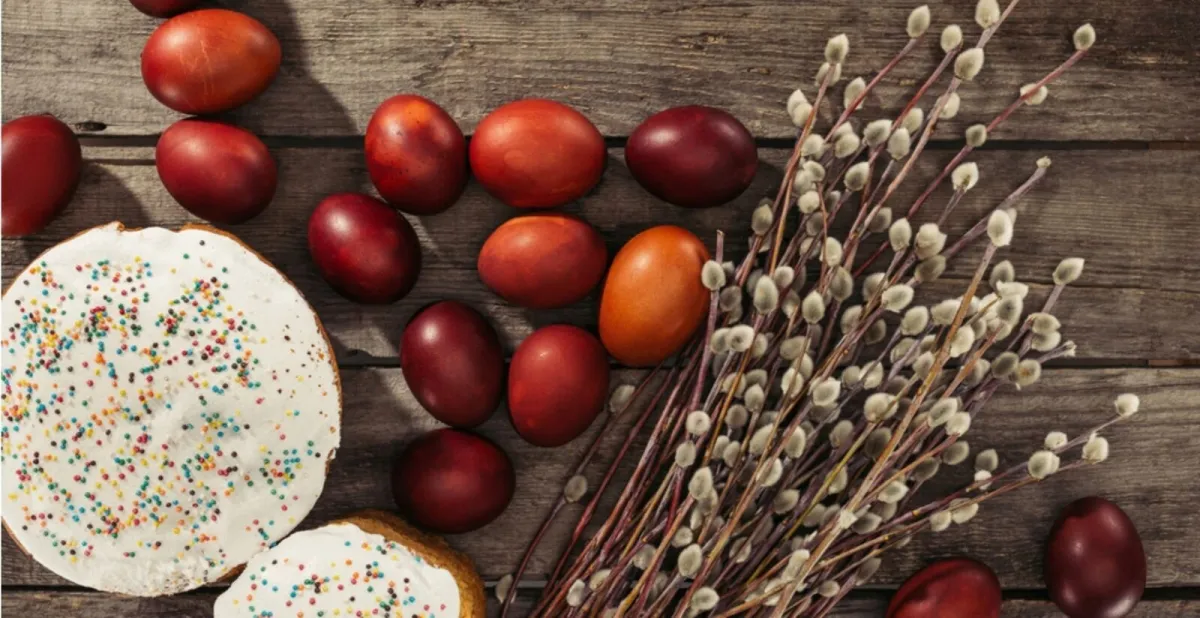
The last week before Easter was called White Week; at this time housewives whitewashed their houses and sowed cabbage “so that it will be white, big and firm”. A notable day of this week is Thursday, called Clean or Passion Thursday. Maundy Thursday is a day of spring cleansing. Even before dawn, before sunrise, villagers cleaned stables, storerooms, yards and houses – everything had to be clean and look festive. According to belief, on Maundy Thursday before sunrise the raven carries its young from the nest to bathe in the river. Whoever bathes earlier than the raven’s chicks will be healthy throughout the whole year. Such bathing cleanses not only the body but also the soul of sins.
On Thursday evening the “Passions” were served in church. Everyone, old and young, kept a solemn calm and observed silence: no laughter, no singing, no loud talk was heard in the street while the Gospel was being read. Returning from church, people tried to carry the Passion candle home so that it would not go out. For this they made special lanterns of coloured glass. Red, blue and green lanterns in the shape of a star or a little church were once a beautiful decoration of this evening. With the flame of the Passion candle a cross was smoked on the doorframes or the ceiling beam, “so that evil spirits would pass the house by”.
The Passion candle in folk belief had great magical power. It was lit when a storm approached, during a serious illness of people or livestock, during difficult childbirth, and placed in the hands of the dying. Peasants cast such candles themselves, “for a candle made by labour is more pleasing to God”. A candle that burned through the 12 Passion Gospels had a particularly great power: it protected the house from everything evil.
On Easter eve it is a sin to sleep, because “whoever does not sleep, God will give happiness, and whoever sleeps will sleep through their happiness”. Also, the light was not put out in the house all night, and a bonfire burned in the church cemetery by the church. There was a belief that at Easter, at sunrise, the sun “plays”, so shutters were opened to let the magical rays of the Easter sun into the house, bringing happiness and health. Greetings and the Easter kiss began only after the service. A pysanka received at the first Easter greeting “averts misfortunes, stops fire”. After the blessing everyone hurried home with the blessed food. There was a belief: whoever returns first will be the quickest to gather their grain in the fields, and bad weather will not touch them.
On arriving, they did not go straight into the house. The owners walked around all the buildings and sprinkled around them blessed salt “to drive away evil spirits”. Only after that did the housewife go into the house, while the master with the blessed food went into the stable to greet the “dumb creatures”. It is still dark there, and the master lit a blessed candle. The stable filled with dim light, and the livestock grew restless, smelling the tasty aromas. Placing the “blessed food” on the back of each animal, the master said: “May this gift be fine, so that God gives you fine calves.” Entering the house, he took off his hat and greeted loudly: “Christ is risen!” “Truly He is risen!” – answered his wife and children. The master set down the basket and exchanged Easter kisses with the family. The children knelt, and the parents unpacked the “blessed food” over their heads, saying: “May your minds untie as quickly as this basket is unpacked.” If there was a girl of marriageable age in the house, the paska was placed on her head with the words: “May you be as majestic as this wheat paska.” A small child was placed in the empty basket with the words: “May you grow as quickly as this paska rises!”
We cannot fail to mention another interesting Ukrainian custom: placing on the Easter table, among the lavish dishes, a bowl heaped with earth from which green grass grows. The greenery should be tall enough to hide an egg. In the dish, among the greenery, they put as many dyed eggs as relatives have died in that house. This symbolic little grave once again reminds us of the great importance our ancestors gave to honouring the souls of the dead.
The family prayed to God and sat down at the table. Breaking the fast, first of all they divided the blessed egg among each family member, who ate their share with the words: “Christ is risen!” After that the young people, taking dyed eggs, went to the churchyard. For three days this area became a lively place where people played egg-tapping games, played, sang and danced round dances. Lads and grown men could ring the church bell tower to their heart’s content, because “God gave Easter for that”. This, according to belief, brought happiness and a harvest of buckwheat.
There was once a custom of swinging on a swing at Easter, the building of which was looked after by the community of young men. It was the centre of entertainment for the whole village; girls, boys, children and respected people crowded there. Unfortunately, it is now only a children’s amusement, but once this custom had a serious purpose: to be cleansed by the air of everything evil that had accumulated over the winter.
On the second day of the Easter holidays, teenage boys and grown men in separate groups went from yard to yard to “exchange Easter greetings”. Coming up to a house, the “greeters” built whole structures out of themselves: three stood on the shoulders of four, and two in turn climbed onto their shoulders, holding firmly onto each other. In this way a living, moving “bell tower” was formed, and so three times they sang “Christ is risen!” After that the “bell tower” collapsed, everyone went into the house and congratulated the hosts on the holiday.
Svitlana Zuber
Senior Researcher at the Pereiaslav National Historical and Ethnographic Reserve


More articles