EVENING GATHERINGS (VECHORNYTSI)
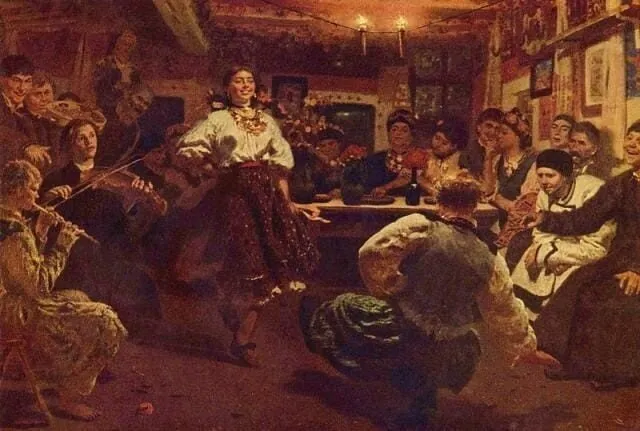
In Ukraine, “vechornytsi” traditionally meant the places where, in the cold season, village lads and girls gathered, got to know one another, grew close and, as a result, married. In summer there were no vechornytsi; they were replaced by the “street”. With the arrival of autumn cold, young people had to change location. Usually they gathered in the warm house of a lone woman, a widow or a soldier’s wife.
We offer to learn more about such youth gatherings using the example of the village of Andrushi, flooded by the waters of the Kaniv Reservoir, in the Pereiaslav region of Kyiv Oblast. In the middle of the 20th century, Dmytro Kosaryk, a researcher at the Institute of Art Studies, Folklore and Ethnography and a writer, worked here and carried out stationary observation of the everyday life and customs of the villagers.
In Andrushi, youth vechornytsi were called “dosvitky”. In Staroselytsia (a quarter of the village) the lads chose a senior lad, called the “berizka”. The “berizka”, heading the community of lads, each year admitted to it seventeen-year-old youths. Each of them contributed a half-ruble in money and half a quart of vodka.
In autumn after the Feast of the Protection of the Mother of God, the girls of the Staroselytsia quarter looked for a house for the dosvitky. Most often a lone widow let them into her homestead. It was to her that mothers entrusted their daughters, charging her to teach them and watch their behaviour. Five to seven girls who lived nearby gathered at one “vechornytsia mother”. Going to the dosvitky, they took their work with them: a spinning wheel, hanks of tow or a distaff with a base. The girls sat on benches along the walls and began to work, talking about the adventures of the day, village news and the lads.
The lads came an hour or two after dusk and began knocking on the bolted door. If they were polite, the “panimatka” (the mistress of the house) let them into the house. The boys greeted cheerfully and sat by the stove, starting some group game. But some went up to the girls and sat among them. A lad who had chosen a girl sat opposite her and began a joking conversation. The girl, in turn, asked him not to disturb her.
Teenagers of about fifteen, who had not yet been admitted to the community of lads, meanwhile ran under the windows of the house and made various mischief: they tied a “furkalo” (a rattle that made the walls shake) to the window, tied the doors shut, blocked the way in front of the threshold, and so on.
As midnight approached, the panimatka addressed the lads: “Boys, leave the house, it is time for the girls to sleep.” However, not all left the yard; a few who had agreed with the girls directly or through an older girl went out into the entrance hall. Meanwhile the girls spread a big bundle of straw in the middle of the floor and covered it with white coarse cloths. The lads came into the house and sat down decorously on the bench. Each girl went up to her agreed “overnight guest”, bent down and began to take off his boots. The bolder girls could look him in the eye and say a word, while the shy ones lowered their eyes to the floor.
In the language of custom and daily life, to take off one’s beloved’s boots meant to spend the night with him. The young people lay down on the prepared bed side by side, taking off only their outer clothing.
The vechornytsia mother, although on top of the stove, listened closely and attentively to the behaviour and whispers on the floor. In case of any suspicion, relying on her customary rights and the authority of a panimatka, she broke up the suspicious couple. She called the girl to sleep on the stove, and the lad went home. It happened that a girl herself ran to the stove, sensing a lad’s rude behaviour. This was a disgrace for the lad, who immediately left the dosvitky.
Decent couples whispered trustingly and, feeling the warmth of mutual affection, arranged further evenings and meetings. But there were also couples who had been meeting for a year, two, or even three. The topic of their night-time talk was future family life, and the obstacles standing on the road to happiness: parental refusal, material hardship, the girl’s young age, or the lad’s conscription into the army. The panimatka trusted such couples completely; such a lad did not allow himself to offend the girl and, on the contrary, protected her from outside advances.
When dawn began to break, the vechornytsia mother reminded the lads: “Time to go home.” If any lad overslept and jumped out of the dosvitky in plain view, he would be whistled at by married men. And at home his father and older brothers shamed the lad and reproached him.
Left alone, the girls hurriedly tidied the bedding, washed and sat down to work for another hour. And as it began to get light, they went home.
However, tragic cases happened too: the consequences of spending the night at the dosvitky included unmarried mothers. Their number grew especially in 1914–1917, during the years of the First World War.
On the first four days of the week the girls spun at the dosvitky, while on Friday, according to customary tradition, it was not fitting to spin, so the girls sewed or embroidered. On Saturday and Sunday no work was allowed; these were holidays, when songs rang out, musicians played, and couples danced so that they knocked holes in the floor with their heels.
Three times during the vechornytsi season the young people held a “skladka”: they contributed foodstuffs, kerosene and firewood. The first “skladka” was at Pushchennia, 27 November, on the eve of the Philip’s Fast. The second was held at Melanka, on New Year’s Eve (13 January), and the third after Epiphany, when they “shot through” the kutia after the holidays.
In addition, the community of lads went carolling during the Christmas holidays. Half of the income they gave for church purchases, and the other half of the carolling proceeds the lads’ community contributed as its share to the girls’ skladka. With this money they bought treats, hired musicians and so on. In these days couples in love agreed on sending matchmakers, because after Epiphany began the most numerous wedding period in Andrushi (and in the Pereiaslav region in general).
Svitlana Zuber, Senior Researcher at the Museum of Ukrainian Rites of the Pereiaslav National Historical and Ethnographic Reserve

More articles