Millstones
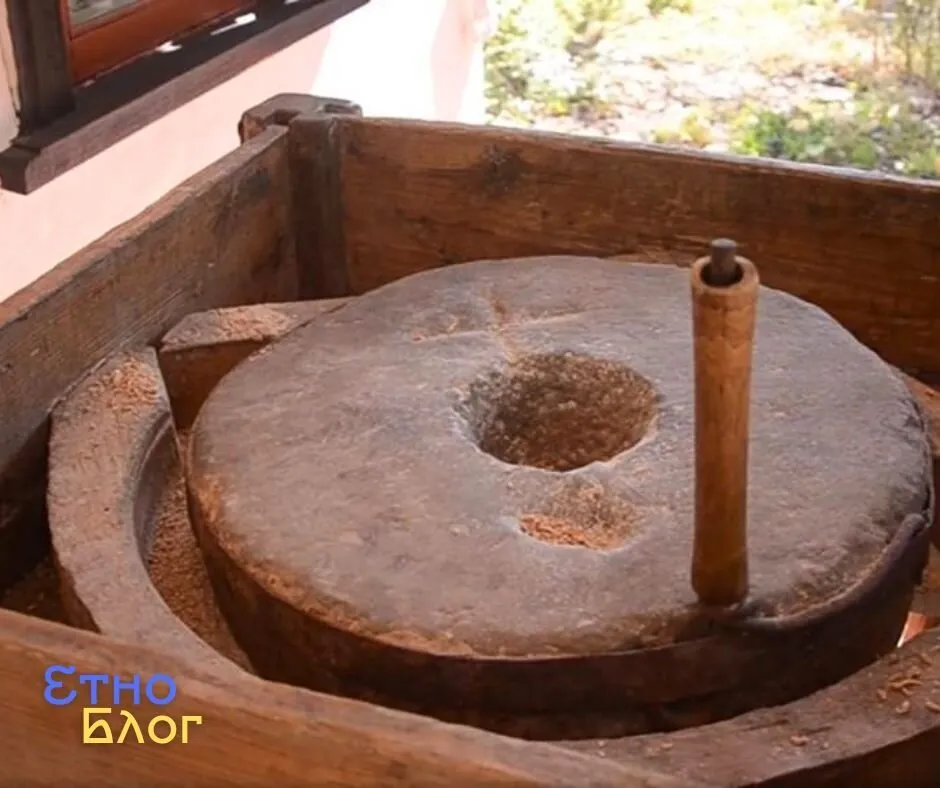
Millstones (zhorna) are one of the oldest and simplest types of milling mechanisms in Ukraine, a device for grinding grain by hand.
The use of primitive millstones on our lands dates back to the early Slavic and Old Rus periods, and their earlier analogue, the grain grinders (querns), to the Neolithic. Millstones became widespread in the Old Rus period, when they became the main milling tool in the household. The oldest written mention of milling with millstones is in the chronicle “The Tale of Bygone Years”: “He ground the grain with his own hands.” Since then millstones played an important role in peasant households for many centuries, until the mid-20th century.
The term “zhorna” comes from the Old Slavic word “zhŭrnŭve”, meaning “heavy”. The mechanism really had considerable weight (one stone of a hand mill is 40–50 cm in diameter, up to 15 cm thick, and weighs several tens of kilograms depending on the material). Millstones for horse-driven, wind, water and steam mills were even larger and heavier (diameter 60–160 cm, thickness 20–50 cm, weight 100–500 kg).
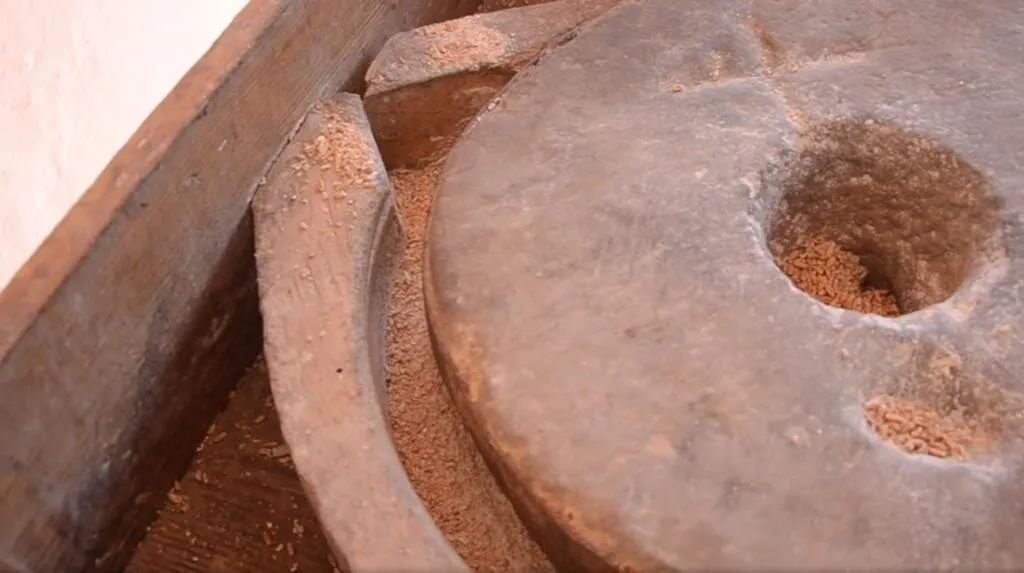
In different regions of Ukraine millstones often had local names: in the Kharkiv region “melnychka” or “mlyn”, in the Luhansk region “mlynok”, in Transcarpathia “mlynets” or “krupnyk”, in the Chernihiv region “mlynok”, in Polissia “muchnyk”, in the Mykolaiv region and Zaporizhzhia “zhorna”.
A hand mill consists of two flat round stones of equal size placed one on top of the other. The lower stone is fixed immovably in a wooden box or buried in the ground, while the upper one is turned clockwise (that is, following the sun) by means of a handle called the “pohonych”. Grain was poured into the hole of the upper stone and ground between the stones. The working surfaces of both stones were often covered with a relief pattern, which improved the grinding of the grain. The upper millstones wore out much more often than the lower ones, although they were more massive and thicker. This is because they directly ground the grain, rotating at a circumferential speed of 9–18 m/s. For this reason the “upper stones” were replaced more often.
In Ukraine hand millstones were divided into two types: open and closed. The first included devices whose stones were partly or fully open, and the flour fell straight onto a spread cloth on the ground. In closed millstones the stones were set in a casing (“obychaika”, “kozhukh”). This type was considered more advanced, since the casing prevented the product from scattering.
To make millstones in Ukraine, locally sourced rocks were used: sandstone, limestone, granite, pyrophyllite schist, flint, tuff. The main thing was that the material be hard and strong enough. In the Middle Dnipro region the most commonly used materials suitable for millstones were grey granites and sandstones. Granite millstones were durable, serving up to 60 years and hardly wearing down, only becoming polished in use, so they had to be dressed often. Millstones even of the strongest sandstone wore out quite quickly, within 2–4 years of intensive work. People said: “a good little stone grinds whatever you put on it, a bad one grinds itself away.” But this did not much affect their popularity among the population, because they were cheap and therefore affordable. It even got the name “millstone grit”. The best material for millstones in Ukraine was considered to be flint. Millstones made of it lasted 150 years or more, without any dressing. Because of the small deposits of this material (mainly the Kremenets Hills, now Ternopil and Rivne oblasts), they were brought from Europe (France) and cost a great deal.
One of the largest and oldest centres of sandstone extraction in Ukraine is the Dnipro bank within the Pereiaslav and Kaniv areas (the Trakhtemyriv deposit). Significant deposits of sandstone suitable for millstones were in the villages of Monastyrok, Zarubyntsi, Hryhorivka, Pishchanyky and Trakhtemyriv. The Brockhaus and Efron Encyclopaedic Dictionary calls the upper millstones made of Trakhtemyriv sandstone the best in the Russian Empire. In areas where stone was scarce, hardwood (oak, aspen) was used to make millstones.
Work with millstones was hard and tedious: “Sweat is wiped by the millstones, songs are sung by the mill”, “Mortar and millstones – a black fate.” Grinding grain was purely women’s work, like all work connected with baking bread. Children were also often involved. In wedding songs, a girl often asks her parents to marry her into a family “where there is a mill, not millstones”.
Worn-out millstones were used as secondary material: in the construction of dwellings and religious buildings (as steps, support stones, foundations, decorative elements), in paving roads and pavements, as marker signs, as raw material for whetstones and grinding wheels, as gravestones (mostly on millers’ graves), or as bases for stone crosses and Jewish matzevot, so that they would not sink.
One can say with great confidence that the millstone is an eternal tool of flour milling. Invented thousands of years ago, they continue to exist despite their so-called primitiveness. They often came in handy in periods of hardship and social upheaval. During the famines of the 20th century millstones saved many Ukrainians from death.
Millstones fell out of household use completely only in the 1960s. But even after that they were for some time used in customary and ritual spheres, in particular in the wedding ritual of preparing the korovai. For it, at least a handful of wheat grain had to be ground with hand millstones.
The collection of the Pereiaslav National Historical and Ethnographic Reserve includes a small but unique collection of 13 hand millstones (9 stone, 4 wooden) dating from the mid-19th century to the 1940s. In addition, the Reserve has a separate collection of millstones used in its interactive events to demonstrate how this milling tool works. Every visitor can make a certain amount of flour with their own hands.
Olena Zham,
Leading Researcher at the Bread Museum of the Research Branch “Museum of Folk Architecture and Life of the Middle Dnipro Region”, Pereiaslav National Historical and Ethnographic Reserve


More articles